Last Updated on 12 October 2026 by Francois Marsteau

Online casinos still use bonuses to get attention, but the bonus is no longer doing all the work. A player might notice the welcome offer first, yet what happens a few minutes later can matter just as much. Does the site load properly on a phone? Can you find the game you were looking for without digging through several menus? Is the cashier clear? Does the platform feel smooth once the first impression wears off? That is where the competition has shifted.

The first few minutes matter more than they used to

Registration is a good example. Long forms used to be accepted as part of the process. Now they can feel unnecessarily heavy, especially when other services have trained people to expect faster access. The growth of the no registration casino model fits into that change. It is not only about skipping a traditional sign-up form. It shows how much value players now place on removing steps that do not feel essential. Even casinos that still use a standard account system have had to make the process cleaner. Too many screens, unclear verification or awkward mobile forms can make a decent platform feel old before the player has even reached the games.

More games can actually make the lobby worse

Game count is another area where bigger does not always feel better. A casino can advertise several thousand titles, but that number means very little if the lobby becomes a wall of thumbnails. Once the choice gets that large, organisation starts to matter more. Good search helps. So do sensible categories and filters that actually narrow things down. Players who already know the provider or game they want do not need to be shown fifty unrelated titles first. This is one of those areas where product quality is easy to notice because bad design wastes time immediately.

The cashier is no longer hidden in the background

Payments used to feel like something separate from the casino itself. You deposited, played, then thought about withdrawals later. Now the cashier is part of how people judge the platform. If deposit options are clear, withdrawal information is easy to understand and the account shows what is happening without making the user chase support, the whole casino feels more competent. If the banking section is confusing, it can undo a lot of the goodwill created elsewhere. A large bonus does not make that irritation disappear.

Mobile use exposes weak choices quickly

Desktop design can get away with clutter because there is room for it. On a phone, every bad decision gets squeezed into a much smaller space. Too many menu items, tiny buttons and slow pages become obvious very quickly. Live casino adds another challenge because the screen has to carry video, betting controls and game information at the same time. A basic slot may be easy to fit onto almost any phone. A live roulette table is a different job entirely. This is why the mobile version can tell you more about a casino’s product quality than the homepage does.

Bonuses still matter, just not on their own

None of this means promotions are becoming irrelevant. They still bring people in. They still give casinos a way to stand out in a crowded market. The difference is that players now have more things to judge once they arrive. A good offer can attract attention, but it cannot fix a frustrating lobby, a poor mobile experience or an awkward withdrawal process. Casino competition is becoming less about the biggest headline and more about whether the platform is still pleasant to use after the headline has done its job.

Last Updated on 20 October 2026 by Francois Marsteau

Press release distribution in France does not require a French subsidiary, a French agency or a French press officer. You need the release in French, a list built for your subject, and someone accountable for the send. This page covers what that involves, what it costs, and where foreign companies usually lose time.

80,000French journalist email contacts
€395one release, France only — from €119.50 in a pack of ten
6–72 hfrom submission to distribution
2009year 24Presse started distributing in France
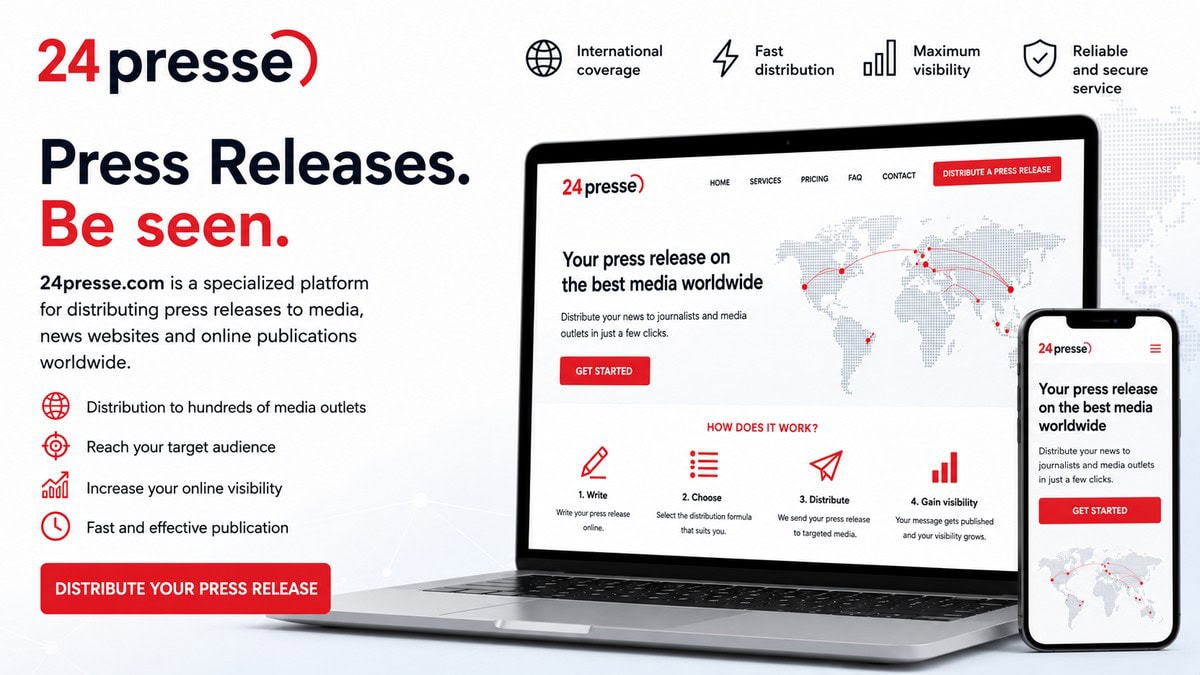
Press release distribution in France with 24Presse: submit a release, choose the scope and reach French media
Submission, scope, distribution. For France the scope is a single country, which is why it is the least expensive plan on the list.

Press release distribution in France: what actually changes

The release has to be in French

This is the point foreign campaigns underestimate most. French desks work in French. A release sent in English is not a release: it is a tip that somebody would have to rewrite before using, and most will not. Translation is not a finishing touch to add if there is budget left — it is the difference between a distribution and a gesture.

If you do not have a French version, have one made before you plan the date. 24Presse sells translation as an option, including in packs of three or five, precisely because it is the step that most often decides whether a campaign lands.

Press release distribution in France needs a French list

Pan-European distribution and press release distribution in France are different products. 24Presse works from roughly 80,000 French journalist email contacts, sorted into 455 journalistic and thematic categories, alongside separate databases for the rest of Europe, the Americas, Asia and Africa. A release aimed at French trade media for the construction sector is not the same selection as one aimed at national business dailies.

That distinction matters commercially too. A one-country distribution costs less than a continental one, and if France is where your news is relevant, paying for four continents buys reach you have no use for.

Two references are worth knowing if you are building a French target list from outside the country. ACPM is the body that certifies circulation and audience figures for French media, so it is where you check whether a title is as widely read as its own media kit claims. And the Reuters Institute’s France chapter sets out how French audiences actually consume news, which is not the same picture as the UK or the United States.

Coverage still cannot be bought

French newsrooms decide independently what they publish, exactly like anywhere else. Distribution puts your announcement in front of the journalists who cover the subject; whether they write about it depends on the news. Any provider who quotes you a number of guaranteed articles in France is selling advertising under another name.

What to have ready before you start

  1. The French text, final. Translated by someone who knows the sector, not only the language. Technical and financial vocabulary is where machine translation gives itself away.
  2. A contact who answers in Paris hours. A French journalist who calls at 15:00 CET and reaches a voicemail in another time zone moves on to the next story. If nobody on your side speaks French, say so in the release and give an English-speaking contact explicitly.
  3. Your targeting decided. Which sectors, and whether the news is national or regional. France has a dense regional press, and a regional angle often travels further than a national one.
  4. Usable images. Correct dimensions, rights cleared.
  5. A date, and 24 hours of margin. If the announcement is tied to a fixed day, submit at least a day ahead and say so at submission.

What press release distribution in France costs

France alone is a one-country distribution. These are the published rates:

One-country planTotalEffective price per release
One release€395€395
Pack of 3€585€195
Pack of 5€745€149
Pack of 10€1,195€119.50

Packs do not expire on a campaign, which is what makes them useful for anyone announcing more than once a year. Wider scopes — one, two, three, four continents or worldwide — are priced separately on the pricing page, along with the options: translation, media monitoring, a dedicated press room, and publication on Google News France.

If you are an agency placing news for clients

Agencies outside France are among our regular customers, and the arrangement is simple: you keep the client relationship, we handle the French distribution. There is no French partner to bring in, no revenue share to negotiate, and no need to explain to your client why a second agency appears on the invoice.

The packs are what make it work economically. At €119.50 per release, French distribution stops being a line item you have to justify and becomes something you can include by default when a client’s news is relevant in France.

How long press release distribution in France takes

Between six and 72 hours from submission, and most of that window is your own approval time rather than ours — the detail is in how long press release distribution takes. Nothing is sent before you have approved the final version.

Afterwards, resist the urge to judge it in 48 hours. French trade monthlies work to production schedules, coverage often appears without a link back, and some of your visibility will now be in AI-generated answers rather than articles — Google sets out its own guidance on how content surfaces in AI experiences. We set out how to read that in why a press release does not get picked up.

The honest summary

Press release distribution in France from abroad is not difficult. It is translation, targeting and a reachable contact — and the first of the three is where foreign campaigns most often come unstuck. Get the French version right and the rest is logistics.

Frequently asked questions

Do I need a French company to distribute a press release in France?

No. A foreign company can distribute in France directly, without a French subsidiary or a local agency. What you need is the release in French, targeting matched to your sector, and a contact journalists can reach.

Does the press release have to be in French?

In practice, yes. French newsrooms work in French, and a release in English is something a journalist would have to rewrite before using. Translation is available as an option, including in packs of three or five.

How much does it cost to distribute a press release in France?

France alone is a one-country distribution: €395 for a single release. Packs bring the effective price down to €195 for three, €149 for five and €119.50 per release for ten. Wider geographic scopes are priced separately.

How many French journalists will receive my release?

24Presse works from roughly 80,000 French journalist email contacts, sorted into 455 journalistic and thematic categories. Your release goes to the categories that match your subject, not to the whole list — relevance decides whether it is used.

Can a PR agency outside France use 24Presse for its clients?

Yes, and agencies outside France are among our regular customers. You keep the client relationship and we handle the French distribution. The packs are what make it economic: at €119.50 per release, French coverage can be included by default rather than justified case by case.

How long does distribution in France take?

Between six and 72 hours from submission, and most of that window is your own approval time. Nothing is distributed before you have approved the final version. If you need a fixed date, submit at least 24 hours ahead and say so at submission.

Planning an announcement that matters in France?

Tell us the subject, the sector and the date. You will get a scope, a price and a realistic timetable — and an honest answer if France is not where your news belongs.

Request a quote — or submit your release if it is already written.