A press release is a concise, factual announcement written for the media. It normally contains a headline, a lead paragraph answering the main questions, supporting facts, one or more attributable quotes, a company boilerplate and a media contact. Its purpose is to help journalists decide whether the announcement is relevant to their audience.
Recommended working length: approximately 400–600 words for most announcements, with one clear news angle.
PR Professional since 2010 and CEO of 24presse.com. Press release distribution, Media relations, Digital PR , Earned media, Press release writing, SEO, AI visibility, Media monitoring, Online reputation, Corporate communication, Journalist databases, Public affairs.
Business School Degree – INSEEC Undergraduate Program in Business Ethics – Fordham University Classe préparatoire HEC
23 articles publishedExpertise: Press relations, Corporate communications, Press release, Press release distribution, Media relations, Journalism, Media visibility, SEO, GEO, Artificial intelligence, Digital communication, Online reputation,
A press release is an official, news-focused document used to communicate a timely announcement to journalists, editors, media outlets and relevant online publications. An effective press release gives the essential facts quickly, explains why the news matters and provides everything a journalist needs to assess, verify and cover the story.
This practical guide explains the definition, purpose, format, writing process and distribution of a press release. It also includes a reusable template, editorial checks, examples and advice drawn from 24Presse’s experience in press release writing and distribution.
What is a press release
A press release, also called a news release or media release, is a structured communication document that announces information considered relevant to the media. It is written on behalf of a company, institution, association, public body, agency or individual and is sent to journalists who may decide to investigate, quote or publish the news.
The press release is an external communication tool for journalists, not a guaranteed article and not an advertisement disguised as editorial content. Its job is to present verifiable facts in a format that can be understood quickly. A journalist must remain free to assess the news, request evidence, interview the organization and choose an independent editorial angle.
A good press release answers the most important questions immediately:
A press release is used to place a factual announcement on the media agenda. Its value comes from the quality of the news, the clarity of the document and the relevance of the journalist targeting—not from repeating promotional claims.
Organizations commonly use press releases to announce:
a product, service or technology launch;
a company creation, expansion or important milestone;
a partnership, acquisition, merger or funding round;
research findings, survey results or a new report;
an event, exhibition, conference or public initiative;
an executive appointment or organizational change;
a certification, regulatory authorization or award;
a crisis response, correction or official company position;
a cultural release, book, film, album or performance;
a local project with a clear community impact.
A press release can support media visibility, credibility and discoverability, but it should be part of a broader public relations process. That process may include direct journalist outreach, interviews, a press kit, supporting visuals, media monitoring and follow-up.
What makes a press release newsworthy
Newsworthiness is the main condition for an effective press release. Before writing, identify the fact that is new and explain why it is relevant now. A weak announcement does not become stronger simply because it is placed in a press release format.
How to Evaluate the News Value of a Press Release
Use these five criteria to determine whether an announcement is relevant,
credible and sufficiently newsworthy for journalists.
News value
Question to ask
Possible evidence
1Timeliness
Why should this be covered now?
Launch date, event date, new regulation or newly published result.
2Impact
Who is affected, and how?
Figures, geographic scope, audience size or measurable consequences.
3Novelty
What is genuinely new or different?
New feature, first result, original method, innovation or discovery.
4Relevance
Why will the target publication’s readers care?
Sector trend, local connection, audience need or public interest.
5Credibility
Can the main claims be independently verified?
Named sources, supporting documents, reliable data and expert contacts.
24Presse tip: the strongest press releases combine several
news-value criteria and support every important claim with verifiable facts.
24Presse recommends testing the central angle in one sentence: “This announcement matters because…” If the answer is vague, promotional or unrelated to the target audience, refine the angle before drafting. Reviewing press release examples and models can help distinguish a real news angle from ordinary company promotion.
Press release structure and format
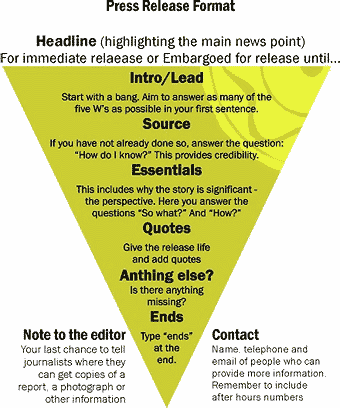
A professional press release follows the inverted pyramid: the most important information appears first, followed by supporting detail and background. This format lets a journalist understand the story quickly and shorten the text from the bottom without losing the essential facts.
24Presse practical guide
Essential Elements of a Professional Press Release
A clear press release structure helps journalists identify the news,
verify the claims and find the information they need without delay.
Element
Purpose
Best practice
1Release status and date
Clarifies when the information may be published.
Use “For immediate release” or state a clear embargo agreed in
advance.
2Headline
States the news.
Be specific, factual and understandable without additional context.
3Optional subheadline
Adds a useful consequence or supporting detail.
Add new information rather than repeating the headline.
4Dateline and lead
Answers the main 5W questions.
Put the strongest and most newsworthy fact in the first sentence.
5Supporting paragraphs
Provides evidence, context and implications.
Use short paragraphs, precise language and verifiable details.
6Quote
Adds attribution, interpretation or human context.
Use a named spokesperson and avoid empty praise or generic
corporate language.
7Boilerplate
Explains who the organization is.
Keep the description factual, concise and consistent across
releases.
8Media contact
Enables verification and interview requests.
Include a monitored email address, a contact name and, where
appropriate, a phone number.
24Presse tip: each section should make the journalist’s
work easier. Remove any sentence that does not clarify, prove or contextualize
the announcement.
How to write a press release in 10 steps
1. Define one primary announcement
Choose one main piece of news. Combining unrelated announcements weakens the angle and makes the press release harder to summarize. Additional information can be placed in a press kit or linked supporting material.
2. Identify the target audience and media
Decide who needs to know and which journalists cover that subject. A local opening, a medical authorization and a technology partnership require different media lists, evidence and vocabulary.
3. Gather verifiable facts
Confirm names, dates, locations, figures, responsibilities, product details and source documents before writing. Separate facts from projections and opinions. A strong press release makes verification easy.
4. Write a factual headline
The headline should state the announcement, not merely describe a topic. Prefer “Company X launches Y to solve Z” to vague wording such as “Company X is changing the future.” Clear terminology also helps search engines and AI systems understand the entity, action and subject.
5. Write the lead paragraph
The first paragraph should provide a complete summary in two or three sentences. Include the organization, the announcement, the date or timing, the location or scope and the main reason it matters.
6. Add evidence and context
Support the lead with concrete details: specifications, numbers, previous milestones, the problem being addressed, relevant context and what happens next. Link to supporting documents when they genuinely help the reader.
7. Add a meaningful quote
A quote should explain significance, intention or impact. It should sound like a person speaking, not like an advertising slogan. Attribute it to a named individual with a clear role.
8. Add the boilerplate and contact
Close with a short factual description of the organization and a media contact who can answer questions promptly. Journalists should not have to search the website to verify who issued the release.
9. Edit for clarity and neutrality
Remove superlatives, repetition, jargon and unsupported claims. Use short sentences, active voice and descriptive vocabulary. Professional press release writing should make the news easier to assess, not make the language louder.
10. Check links, formatting and distribution readiness
Test every URL, confirm contact details, proofread names and figures, compress images and preview the release on mobile. Then choose the most relevant distribution method rather than sending the same generic message to every media contact.
Press release template
The following structure can be copied into a document or the WordPress editor and adapted to the announcement.
For immediate release
Professional press release template by 24Presse
Clear headline stating the announcement
Optional subheadline explaining the main benefit, result or consequence
Location:City, CountryDate:Day Month Year
CITY, Country — Date — Organization name today announced the main news. Explain who is affected, why it matters and when it
becomes effective.
Provide the strongest supporting facts, figures, context or evidence.
Explain precisely what is new, how it works and what distinguishes the
announcement from existing alternatives.
A useful quotation that explains the significance, impact or wider
context of the announcement. Add a second sentence that provides perspective rather than simply
repeating the lead paragraph. — Full name, Job title at Organization
Add relevant background information, availability, next steps,
eligibility conditions, geographic scope or a link to useful supporting
material.
About Organization
Write two or three factual sentences describing the organization,
its principal activity, location, history and relevant expertise.
Avoid promotional superlatives and claims that cannot be verified.
One press release should communicate one primary announcement. A focused angle improves comprehension, targeting and the likelihood that the story can be summarized accurately.
Use an appropriate length
Most routine releases can be covered in approximately 400–600 words. Complex research, legal or technical announcements may need more context, but extra detail should remain relevant and easy to scan. The principle behind “the shorter the better” is not to omit evidence; it is to remove everything that does not help the journalist understand or verify the news.
Write for journalists, not for advertising
A press release should inform. Avoid claims such as “revolutionary,” “world-class,” “unique” or “best” unless they are precisely defined and supported. An older but still useful external writing reference is Marketing Donut’s guide to an effective press release.
Make the release easy to read
Use descriptive headings, short paragraphs, bullets and tables where they improve comprehension. Do not hide the key fact halfway down the page. A person unfamiliar with the organization should understand the announcement within a few seconds.
Use links selectively
Link to a landing page, report, image library, registration page or source document only when it supports the announcement. Too many links make the document look promotional and distract from the central story.
Send accessible material
When pitching by email, place the essential message in the email body or provide an accessible web version. Attachments can create friction, particularly when they are large or unexpected. High-resolution assets can be offered through a clearly labelled media link.
Date and identify the issuer
Make the issuing organization, publication date, release status and media contact visible. An undated or anonymous document creates unnecessary doubt about authenticity and freshness.
Press release vs media pitch, article and press kit
24Presse comparison guide
Press Release and Media Content Formats Compared
Press releases, pitches, press kits and articles serve different
communication purposes. This comparison helps you choose the right
format for each media relations objective.
Format
Main purpose
Typical content
01 Press release
Present a complete, official announcement.
Headline, lead paragraph, verified facts, quotation, company
boilerplate and media contact information.
02 Media pitch
Persuade a specific journalist to consider a relevant story angle.
A short, personalized email explaining why the proposed angle is
relevant to the journalist, publication and audience.
03 Press kit
Provide detailed supporting resources for journalists.
Company facts, spokesperson biographies, photographs, logos,
reports, background documents, videos and frequently asked
questions.
04 News article
Inform readers through independent editorial work.
Original reporting, wider context, several sources, verification
and independent editorial judgment.
05 Sponsored article
Publish paid branded content on a media or specialist website.
Promotional, informative or educational branded content that is
clearly identified as sponsored or paid.
24Presse tip: a press release supplies official source material, while a news article is
produced independently by a journalist. Sponsored content must always be
clearly identified as paid communication.
A press release may support a pitch, while a press kit provides the deeper material that cannot fit in the release itself. These formats are complementary but should not be confused.
How to distribute a press release
Press release distribution means delivering the announcement to the journalists, media outlets and online audiences most likely to consider it relevant. Distribution quality depends on targeting, timing, deliverability, presentation and follow-up.
1. Publish a stable web version
Host the release on a permanent, indexable page with a clear title, publication date, organization name, contact details and shareable URL. This gives journalists and search engines a reliable source to reference.
2. Build a relevant media list
Select journalists by subject, outlet, geography, language and audience. Relevance is more valuable than list size. A carefully selected group of contacts usually produces better conversations than a mass email sent without editorial matching.
3. Personalize the outreach
Explain briefly why the announcement fits the journalist’s beat or recent work. This does not require a long email; it requires a relevant reason. See these practical tips for contacting journalists and the media.
4. Choose an appropriate distribution channel
Depending on the announcement, distribution may combine direct outreach, a PR agency, a specialist platform, a newsroom page, social media and sector-specific publications. The complete process is described in the five steps of press release distribution and in this complementary guide to press release distribution.
5. Time the release carefully
Avoid sending important news without checking deadlines, time zones, events, holidays and competing announcements. Embargoes should be used only when there is a clear reason and when recipients have agreed to the restriction.
6. Follow up professionally
A short, relevant follow-up can be appropriate when the journalist has not responded. Repeated generic reminders are counterproductive. Be available to provide evidence, visuals, an interview or clarification.
Do not measure success only by page views or the number of emails sent. Evaluate whether the release reached relevant media, generated qualified interest and supported the organization’s communication objective.
Delivery: successful sends, bounces and inbox placement.
Engagement: journalist replies, requests for information and interview opportunities.
Media coverage: articles, broadcasts, newsletters, podcasts and specialist mentions.
Quality: relevance of outlets, accuracy of coverage, message inclusion and audience fit.
Referral activity: visits, registrations, downloads or enquiries attributable to coverage.
Long-term visibility: citations, branded search, backlinks and discoverability of the announcement.
Build a press coverage record after distribution. A media clipping tool can centralize coverage, while Bookizer can help organize and present a media coverage report.
Real-world examples
Press Release Examples by Announcement Type
The best way to understand the format is to compare real announcements
across sectors. These examples show how press releases can cover health,
technology, corporate development, music and finance.
01
Health and Regulatory Announcements
4 examples
Industrial partnership Théa and Unither Pharmaceuticals announce an industrial
partnership for a new ophthalmic manufacturing facility Read the release
FDA clearance Cercare Medical receives FDA 510(k) clearance for AI-powered
brain tumor segmentation Read the release
Medical technology Cercare Medical receives FDA 510(k) clearance for cone-beam
CT perfusion Read the release
Global collaboration Siemens Healthineers and Cercare Medical announce a global
collaboration Read the release
02
Corporate Expansion and Partnerships
3 examples
European growth ADVANS Group accelerates its growth in Europe and strengthens
its expertise Read the release
International expansion ADVANS Group expands into Italy with a new presence in Milan Read the release
Executive appointment Ricardo Kaufmann joins Lior Global Partners as managing director Read the release
03
Technology, Consumer and Cultural News
3 examples
Digital platform Made-in-US.com launches a U.S. vehicle purchasing platform Read the release
Original soundtrack The Samurai and the Prisoner original soundtrack, with music
by Yoshihiro Hanno Read the release
24Presse selection: real announcements published across health, business, technology,
finance and cultural sectors.
Common press release mistakes
No real news: the document promotes ordinary activity without a timely, relevant development.
A vague headline: the reader cannot identify the organization, action or consequence.
A promotional lead: the first paragraph uses claims instead of facts.
Too many topics: several unrelated announcements compete for attention.
No evidence: numbers, awards, comparisons or market claims cannot be verified.
Generic quotes: the spokesperson says the organization is “delighted” without adding information.
Poor targeting: the release is sent to journalists who do not cover the subject or location.
Missing contact details: there is no clear person available for questions.
Heavy attachments: the recipient must download large files before understanding the story.
No proofreading: incorrect names, dates and links damage credibility.
No follow-up plan: the organization cannot provide an interview, image, document or clarification.
Journalists have more potential stories than they can publish. This older Forbes discussion of what journalists think of press releases reinforces a durable principle: clarity, relevance and usability matter more than hype.
24Presse editorial checklist
Based on day-to-day work with press release writing and distribution, 24Presse recommends completing this check before publication.
24Presse final review
Press Release Quality-Control Checklist
Review these ten points before distributing a press release to ensure
that the announcement is clear, credible, useful to journalists and
correctly targeted.
Check
Pass criterion
01News
The announcement is new, timely and relevant to a clearly defined
audience.
02Headline
The organization and main action are understandable without
reading any further.
03Lead
The first paragraph answers the essential 5W questions: who,
what, when, where and why.
04Evidence
Important claims are supported by facts, named sources, figures
or verifiable documents.
05Neutrality
Unsupported superlatives, advertising language and excessive
promotional claims have been removed.
06Quote
The quotation adds interpretation, context or perspective and is
attributed to a named person.
07Entities
People, organizations, products, brands and locations are named
clearly and consistently.
08Contact
A genuine and monitored media contact can answer questions or
arrange an interview promptly.
09Links
Every internal and external link works correctly and has a clear
editorial purpose.
10Targeting
The media list matches the announcement’s topic, industry,
geographic area and intended audience.
Final step 24Presse tip: do not distribute the press release until every criterion can be
confidently marked as passed.
Press release FAQ
What is a press release?
A press release is an official, factual announcement prepared for journalists and media outlets. It summarizes news in a standard format and provides supporting information, attribution and contact details.
Why are press releases important?
Press releases help organizations communicate verified news consistently, make information easier for journalists to assess and create a permanent source that can support media outreach, public information and online visibility.
How do you write an effective press release?
Start with one newsworthy fact, write a clear headline and summarize the 5W questions in the lead. Add evidence, useful context, an attributable quote, a factual boilerplate and a media contact, then edit for clarity and neutrality.
What is the ideal length of a press release?
Approximately 400–600 words is suitable for many announcements. The correct length is the shortest version that communicates the news accurately and provides enough evidence for a journalist to evaluate it.
What makes a press release newsworthy?
A press release is newsworthy when it contains timely and relevant information with a clear impact, novelty, public interest or connection to the target audience. Product launches, partnerships, research, funding, appointments, events and regulatory decisions are common examples.
What is the inverted pyramid method?
The inverted pyramid places the most important information at the beginning, followed by supporting facts, quotes and background. It improves scanning and lets editors shorten the release from the bottom without removing the core news.
Should a press release be optimized for SEO?
It should use clear, natural terminology, descriptive headings, meaningful links and accurate entity names. However, the primary audience is still journalists and readers. Repeating a keyword unnaturally or adding irrelevant links reduces quality.
Can AI write a press release?
AI can help create an outline, identify missing information or improve clarity, but a responsible editor must verify every fact, quote, name, date and claim. Confidential information, legal risk, tone and newsworthiness require human judgment.
How do journalists evaluate a press release?
Journalists typically assess relevance to their audience, news value, credibility, clarity, supporting evidence and the availability of a useful contact. A well-formatted release cannot compensate for irrelevant or unverifiable information.
How do you distribute a press release?
Publish a stable online version, identify relevant journalists, personalize the outreach and use the appropriate combination of direct email, a distribution service, a PR agency and owned channels. Track replies and coverage, then follow up only when there is a useful reason.
Should a press release be sent as an attachment?
The essential announcement should be readable without opening an unexpected attachment. Place the main information in the email or link to an accessible web version, and provide downloadable images or documents separately when needed.
What should appear at the end of a press release?
Include a factual company boilerplate and media contact details. Depending on the announcement, you may also include a link to supporting assets, registration information or a source document.
Conclusion: a press release should make credible news easy to use
An effective press release combines a genuine announcement, a clear journalistic structure, verifiable information and relevant distribution. It should help a journalist understand what happened, why it matters, who can confirm it and where to find supporting material.
The strongest improvements rarely come from adding more promotional language. They come from sharpening the news angle, improving evidence, simplifying the headline and lead, choosing the right media contacts and making follow-up easy.