Media monitoring cost at a glance
Media monitoring cost depends on the number of subjects, brands, competitors, countries and media sources that need to be monitored, as well as the frequency and depth of the final report. A simple one-off online press review may require a budget in the low hundreds of euros, while continuous multi-country monitoring across online media, print, radio and television normally requires a personalised quotation.

A professional press review does more than collect links. It identifies relevant coverage, removes duplicates, organises the results, adds useful context and delivers a clear document that can be shared with managers, clients, partners or investors.
Media monitoring cost: quick answer
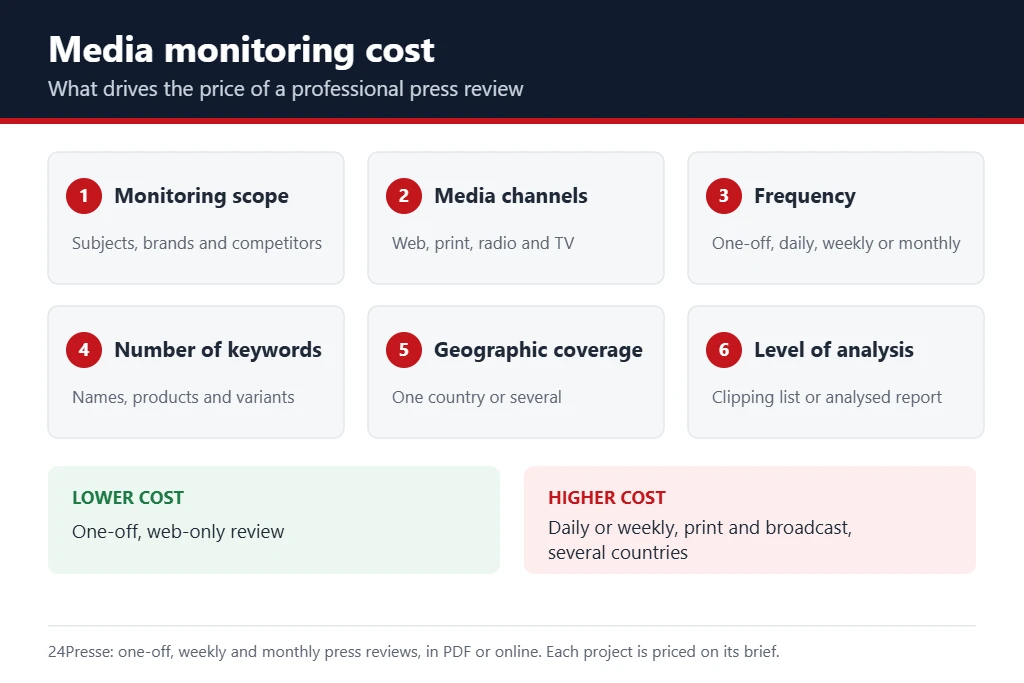
The price is mainly determined by the monitoring scope, media channels, frequency, number of keywords, geographic coverage and level of analysis. A one-off web-only review is normally the least expensive option. Daily or weekly monitoring covering print, broadcast and several countries is more expensive because it requires broader access, continuous verification and more editorial work.
24Presse provides one-off, weekly and monthly press reviews in PDF or online format. Each project is priced according to the exact brief.
What is media monitoring
Media monitoring is the systematic process of finding, collecting and reviewing references to a company, brand, person, product, competitor or subject across relevant media.
Depending on the brief, and therefore on the media monitoring cost, monitoring may cover:
- online news websites;
- newspapers and magazines;
- trade and specialist publications;
- news agencies;
- radio programmes;
- television broadcasts;
- podcasts and video platforms;
- selected blogs and professional websites;
- social media, when social listening is included.
The purpose is not simply to create a list of URLs. Effective media monitoring helps an organisation understand what has been published, where it appeared, which subjects generated attention and how its visibility compares with that of competitors.
It can also reveal inaccurate information, emerging reputational issues, recurring questions from journalists and new market trends. This makes monitoring useful for public relations, corporate communications, public affairs, crisis management, marketing and competitive intelligence.
An international publication such as France 24’s international press review illustrates how media coverage can be selected, organised and interpreted around a specific subject.
What is a professional press review
A professional press review, also called a media review or press clipping report, presents the most relevant media coverage in a structured and readable format.
It can include:
- the publication or broadcaster;
- the article, programme or segment title;
- the publication date;
- the journalist or author;
- a link to the original coverage;
- an extract, screenshot or authorised clipping;
- the media category and country;
- the subject, brand or spokesperson mentioned;
- a short editorial summary;
- qualitative observations or performance indicators.
A press review is therefore different from a raw alert feed. Automated alerts may collect hundreds of results, but many will be duplicated, irrelevant or too weak to justify inclusion. A professional review applies editorial judgement before the information is delivered.
The final document should be easy to scan and sufficiently clear for someone who did not participate in the original media campaign. It may be delivered as a PDF, an online report, a dashboard or a combination of formats.
Organisations that want to manage part of the process internally can also use a dedicated media clipping tool such as Bookizer.
How much does media monitoring cost
There is no universal media monitoring price because the workload can vary considerably from one brief to another.
A company asking for a one-off review of ten online articles has a very different requirement from an international organisation that wants daily monitoring of hundreds of publications, television channels, radio programmes and competitors.
For budgeting purposes:
- a one-off online press review is usually the lowest-cost professional option and may require a budget in the low hundreds of euros;
- monthly web monitoring generally costs several hundred euros per month, depending on the number of keywords and results;
- weekly multi-source monitoring may require a budget ranging from the high hundreds to the low thousands of euros per month;
- daily, international or broadcast monitoring is normally priced through a personalised quotation and can require a four-figure monthly budget.
These figures are broad planning indications rather than fixed 24Presse prices. The final cost depends on the exact scope, access requirements and amount of editorial processing.
A transparent provider should explain what is included, what may generate an additional charge and whether the fee covers only access to a monitoring platform or also includes human review and a finished report.
Media monitoring cost: pricing guide
The least expensive proposal is not necessarily the best value. A low-cost feed containing hundreds of irrelevant results can create more work for the client than a smaller, professionally selected review.
What affects media monitoring cost and press review pricing
1. Number of monitored keywords
Each additional brand, product, executive, campaign, competitor or subject expands the monitoring scope. Complex names may also require exclusions and contextual searches to avoid irrelevant results.
2. Media channels
Online news monitoring is normally easier to automate than print, radio or television monitoring. Broadcast and print sources may require specialised databases, licences, transcription or manual verification.
3. Geographic coverage
Monitoring one national market is less complex than monitoring several countries. International projects may require multilingual searches, local media knowledge and the normalisation of results from different databases.
4. Monitoring frequency
A one-off review has a defined beginning and end. Daily monitoring requires continuous collection, verification and rapid delivery. The greater the frequency, the greater the recurring workload.
5. Volume of coverage
A niche organisation may generate a few relevant mentions each month. A public company, celebrity, major brand or controversial subject may generate hundreds or thousands of potential results.
6. Required response time
A monthly report can be prepared within an agreed production window. Real-time crisis alerts or reports delivered before an executive meeting require faster review and additional availability.
7. Level of analysis
A basic clipping report presents the selected coverage. A more advanced report may classify themes, markets, spokespeople, products, sentiment, prominence, reach or share of voice.
8. Report format and presentation
A simple spreadsheet is faster to produce than a fully designed PDF with a cover, contents page, editorial summaries, charts and client branding.
9. Copyright and reproduction rights
Some media content can be linked to freely, while other articles, broadcasts or screenshots may be subject to access and reproduction restrictions. These conditions can affect the service structure and price.
10. Human verification
Human review removes false positives, repeated syndications and weak references. It also helps distinguish a substantial article from a passing mention. This editorial work increases quality but also influences the final price.
What is included in a professional press review?
The media monitoring cost of a clearly defined professional service may cover all or part of the following:
- definition of the monitoring brief;
- creation of keyword and exclusion queries;
- selection of relevant media sources;
- automated and manual searches;
- verification of names, dates and publications;
- removal of duplicates and irrelevant mentions;
- classification by subject, media type, country or campaign;
- links to original articles and broadcasts;
- editorial summaries or extracts;
- PDF or online presentation;
- company branding and report formatting;
- comparison with competitors;
- regular email delivery;
- urgent alerts for sensitive coverage;
- qualitative or quantitative analysis.
Before comparing media monitoring prices, check whether each proposal includes editorial selection and report production. Some providers sell access to software only. Others deliver a complete service in which a communications professional validates the results before delivery.
Media monitoring cost: one-off, weekly or monthly monitoring
One-off press review
A one-off press review is appropriate after a product launch, event, funding announcement, crisis, report publication or other defined campaign.
The client provides the subject and date range. The provider searches for coverage, selects the useful items and creates the final report. This model avoids a recurring subscription and is suitable when media activity is occasional.
Weekly press review
A weekly report gives communications teams a regular view of coverage without overwhelming recipients with daily alerts. It is often suitable for active companies, public institutions and PR agencies.
The report can highlight the most important article of the week, new subjects, competitor activity and any coverage that requires a response.
Monthly media monitoring report
A monthly review is useful for management reporting and long-term performance monitoring. It can show how visibility has changed, which subjects attracted attention and which publications covered the organisation most frequently.
Monthly monitoring can also support a broader public relations agency strategy by connecting media results with ongoing communication objectives.
Daily and real-time monitoring
Daily monitoring is appropriate when reputation, regulation, investor communication, public affairs or crisis response makes speed essential.
In this case, the organisation may need immediate alerts as well as a consolidated weekly or monthly report. The monitoring price is higher because collection and verification must remain active throughout the agreed period.
Online, print, radio and television monitoring
Online media monitoring
Monitoring of digital sources covers news websites, trade publications, professional blogs and other selected websites. It is generally the easiest channel to search and link to, which keeps media monitoring cost lower, although paywalls and changing URLs can complicate access.
Print press monitoring
Print monitoring covers newspapers, magazines and trade publications. It may require access to specialist databases and attention to publication dates, editions and regional versions.
Radio and television monitoring
Broadcast monitoring can identify spoken references that do not appear in search engines. It may require audio or video databases, transcripts and manual review to confirm the context and duration of the mention.
Social media monitoring
Social listening focuses on conversations and engagement on social platforms. It is related to media monitoring but is not identical to it. A press review normally concentrates on editorial media coverage, while social listening analyses user-generated conversations.
Both can be combined when an organisation needs a broader view of reputation and audience response.
DIY, software or professional service: comparing media monitoring cost
| Solution | Advantages | Limitations | Suitable for |
|---|---|---|---|
| Free alerts and manual searches | Low direct cost and simple setup | Incomplete coverage, duplicates and substantial internal work | Very small volumes and occasional checks |
| Self-service monitoring software | Automation, dashboards and greater control | Requires configuration, review and internal reporting time | Teams with their own monitoring resources |
| Professional press review service | Verified results and a finished, shareable report | Higher direct cost than a basic alert tool | Organisations that value time, quality and presentation |
| Hybrid solution | Software access combined with professional support | Requires a clearly defined division of responsibilities | Growing communications teams and agencies |
Creating a professional report internally can be more expensive than it first appears. The real cost includes employee time spent searching, opening articles, removing duplicates, cropping clippings, checking dates, creating summaries and formatting the final document.
A dedicated platform such as Bookizer’s press review tool can reduce much of the manual layout work. A managed service goes further by taking responsibility for selection, verification and presentation.
How 24Presse creates a professional press review
24Presse can produce one-off or recurring press reviews in PDF or online format. The process begins with a precise brief rather than a generic keyword search, which also keeps the media monitoring cost under control.
Step 1: define the objective
The first question is why the monitoring is required. The objective may be to document a campaign, report to management, detect reputational issues, compare competitors or understand a market.
Step 2: identify the monitored entities
We identify the company names, brands, products, executives, campaigns, competitors and subjects that must be tracked. Alternative spellings and exclusions may be added to improve accuracy.
Step 3: select the media scope
The brief specifies the countries, languages and media categories to include. A local launch does not require the same source list as an international corporate campaign.
Step 4: collect potential coverage
Professional monitoring tools and manual research are used to locate relevant coverage. The results are then checked rather than added automatically.
Step 5: remove noise and duplicates
False positives, copied articles, repeated syndications and irrelevant mentions are excluded. When several websites reproduce the same content, they can be grouped or presented separately according to the reporting objective.
Step 6: organise the results
Coverage can be classified by date, country, source type, campaign, product, spokesperson, subject or competitor.
Step 7: create the report
The selected content is formatted into a coherent document. A professional layout makes the report easier to read and more credible when it is shared with a client, executive or partner.
Step 8: deliver and refine
The report is delivered according to the agreed frequency. Search queries and selection rules can then be refined when new terms, competitors or priorities emerge.
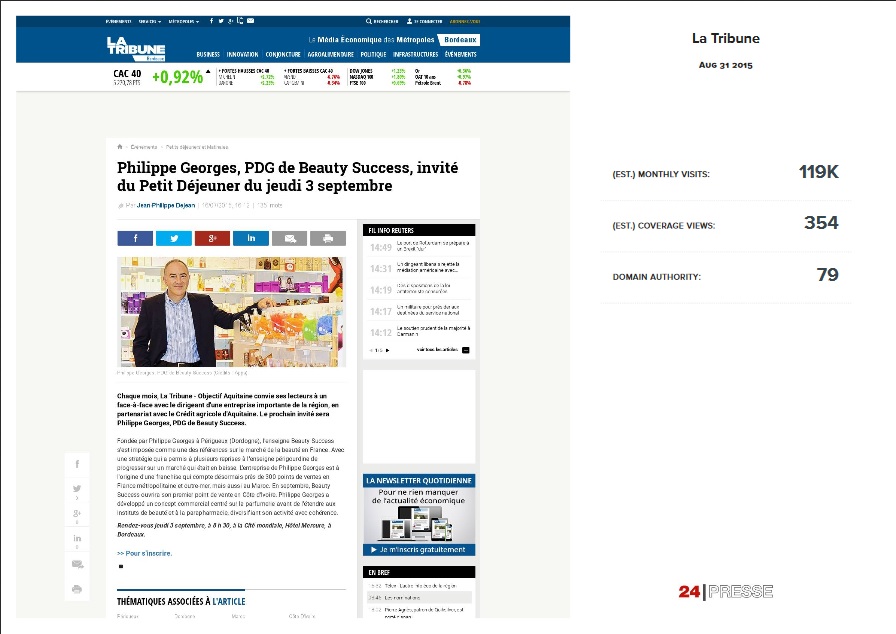
Example of a 24Presse press review
24Presse can deliver a report as a downloadable PDF or as an online document that is easy to share.
View an example of a press review produced by 24Presse.
This example illustrates how articles and clippings can be presented in a consistent layout instead of being copied into an unstructured Word or PowerPoint document.
A real client report may also contain a cover page, contents page, campaign summary, source details, publication dates, article links and a final overview. Confidential information can be removed or anonymised before an example is made public.
Competitor and industry monitoring
A press review should not necessarily be limited to the organisation’s own name. Adding competitors increases the media monitoring cost, but it often brings the most strategic insight.
Competitor monitoring can reveal:
- new product launches;
- partnerships and acquisitions;
- executive appointments;
- new markets and geographic expansion;
- pricing or positioning changes;
- recurring media messages;
- journalists interested in the sector;
- negative coverage or reputational weaknesses;
- subjects that generate the strongest media attention.
Tracking competitors also provides context. Ten articles may appear impressive in isolation, but the result has a different meaning if the main competitor received fifty articles during the same period.
A comparative review can therefore include share of voice, media categories, subject distribution and the relative prominence of each organisation.
How to measure the return on media monitoring cost
The return on media monitoring cost should not be reduced to the number of clippings collected.
Useful indicators may include:
- number of relevant media mentions;
- number of unique publications;
- quality and authority of the sources;
- prominence of the company or spokesperson;
- presence in the headline or opening paragraphs;
- positive, neutral or negative context;
- key messages reproduced by the media;
- countries and audience segments reached;
- competitor share of voice;
- links, referral traffic or enquiries generated;
- issues detected early enough to support a response;
- internal time saved through outsourced research and formatting.
A press review is also a credibility tool. Independent editorial coverage can support sales presentations, investor communication, recruitment, internal communication and business development.
However, media coverage should remain a means of reaching the organisation’s real audiences rather than an objective in itself. Journalists are intermediaries, not usually the final corporate audience.
For this reason, monitoring should be connected to the wider communications plan, including the organisation’s press release strategy, journalist outreach and audience priorities.
How to choose a media monitoring provider
Before selecting a provider and comparing media monitoring cost, ask the following questions:
- Which media sources are covered? Check whether the proposal includes online, print, radio, television and social sources.
- Which countries and languages are included? International coverage should be defined precisely.
- Are results verified by a person? Automated feeds alone can contain substantial noise.
- How are duplicates handled? The provider should explain how syndicated and repeated content is treated.
- What will the final report look like? Request an anonymised example before ordering.
- Are summaries and analysis included? A clipping service and an analytical report are not the same product.
- How quickly are urgent mentions delivered? This matters for crisis and reputation monitoring.
- Can the monitoring brief evolve? New competitors, products and search terms may need to be added.
- What is included in the quoted price? Clarify setup fees, access costs, editorial work, reporting and optional services.
- Who owns and can use the final report? Confirm any restrictions associated with reproduced media content.
A clear brief is the most reliable way to obtain comparable quotations. It should state the monitored entities, countries, languages, source types, date range, frequency, expected format and level of analysis.
Media monitoring cost FAQ
How much does media monitoring cost?
Media monitoring may cost from a few hundred euros for a limited one-off review to several thousand euros per month for continuous international monitoring. The exact price depends on the number of keywords, media channels, countries, results and reporting requirements.
What determines professional press review pricing?
The main factors are the monitoring scope, frequency, number of sources, geographic coverage, volume of mentions, response time, report format and level of human analysis.
Is a one-off press review cheaper than a subscription?
A one-off review normally has a lower total cost because it covers a defined campaign or date range. A recurring service may provide a lower effective cost per report when weekly or monthly monitoring is required over a longer period.
Does print, radio or television monitoring cost more?
It often does. These channels may require specialist databases, licences, transcripts and additional manual verification that are not required for a basic online search.
Can media monitoring include competitors?
Yes. Competitor monitoring can be added to compare media visibility, messages, launches, executives, reputation and share of voice.
What is the difference between media monitoring and a press review?
Media monitoring is the ongoing process of finding and evaluating coverage. A press review is the organised report created from the selected monitoring results.
What is the difference between media monitoring and social listening?
Media monitoring usually focuses on editorial coverage produced by journalists and media organisations. Social listening focuses on conversations and user-generated content published on social platforms.
Can a press review be delivered as a PDF and online?
Yes. 24Presse can prepare a PDF document, an online version or both, depending on the sharing and reporting requirements.
How often should a press review be delivered?
The appropriate frequency depends on media activity and business risk. Monthly reports suit many organisations, while active campaigns may require weekly reporting and sensitive situations may require daily alerts.
Can free alerts replace a professional monitoring service?
Free alerts may be sufficient for occasional basic searches, but they rarely provide complete coverage, reliable filtering, professional presentation or access to print and broadcast sources.
How long does it take to create a press review?
A small one-off report can often be produced quickly once the brief and source material are confirmed. Larger reports require more time for collection, verification, classification and formatting.
How can a company reduce its media monitoring cost?
Limit the brief to relevant keywords, prioritise essential countries and media channels, choose an appropriate reporting frequency and separate critical alerts from routine coverage.
How is the return on media monitoring measured?
Return can be assessed through time saved, useful coverage detected, reputational risks identified, campaign reporting improved, competitor intelligence obtained and business actions supported by the information.
More questions about briefs, reports and data
Should a media monitoring brief include spelling variants?
Yes. Include brand names, product names, executive names, common misspellings, abbreviations and relevant exclusions. This improves recall while reducing irrelevant results.
What is a negative keyword in media monitoring?
A negative keyword excludes unrelated mentions that share the same word or name. It is one of the simplest ways to improve precision and reduce manual filtering.
Can media monitoring cover several languages?
Yes. Multilingual monitoring is useful for international organisations, but each language requires adapted queries, local source coverage and human validation.
What is share of voice in a press review?
Share of voice compares the volume of relevant coverage received by one brand with the total coverage received by a defined group of competitors.
Can a press review measure sentiment?
Yes, but sentiment should be treated as an analytical aid rather than an absolute fact. Human review is recommended for irony, ambiguity and specialist terminology.
What should an executive summary contain?
It should identify the main developments, strongest coverage, emerging risks, opportunities, competitor movements and recommended actions.
How long should media monitoring data be retained?
Retention depends on legal, operational and reporting needs. Organisations should define a documented policy covering access, copyright, personal data and deletion.
Can a press review support crisis communication?
Yes. Faster monitoring, verified alerts and clear escalation rules help communication teams detect reputational issues and coordinate an evidence-based response.
Should duplicate articles be removed?
Usually yes. Syndicated copies should be grouped or labelled so that reach is not confused with the number of genuinely distinct editorial articles.
What makes a media monitoring report actionable?
An actionable report connects coverage to decisions. It highlights what changed, why it matters, who should respond and what should happen next.
Related PR and media relations resources
Media monitoring is most useful when it is connected to a coherent public relations process. These resources explain the other stages of that process:
- How to contact journalists and the media
- How to send press releases
- How to send a press release to the right journalists
- What is a press release?
- Professional press release writing
- Press release writing guide
- Press release examples and models
- Press release examples and free templates
- Press kit examples and best practices
- Press release distribution in five steps
- Press release distribution pricing
- What a PR agency does
- Why a press release does not get picked up
Further reading on press releases, earned media and PR performance:
- Muck Rack: press release best practices
- Public Relations Society of America: writing for media coverage
- PRLab: public relations statistics
- Axios: what journalists expect from PR content
- Flair: public relations statistics
- eReleases: data-backed press releases
- Wiztrust: earned media and generative AI search
- Cision: earned media strategy
Request professional press review pricing
To receive an accurate quotation, specify the brands or subjects to monitor, countries, languages, media sources, date range, delivery frequency and preferred report format. You can also request a PR agency quote online.
Contact 24Presse to request a personalised media monitoring and press review quotation.